Showing posts with label History. Show all posts

Friday, December 16, 2022

Learn N Blog #20: Off 15th December

Came across one of the weird connects from history

15 Dec 1944, Imphal
Two officers of the then British Indian Army are decorated with the Military Cross by the Viceroy Lord Wavell for their services in 2nd World War. Their names
  • Major Sam Manekshaw, 12th Frontier Force Regiment
  • Lt. AAK Niazi, 14th Army
Fast forward 27 years to same date
15 Dec 1971
Lt. Gen Niazi conveys the decision to surrender the Pakistani Eastern Command to General Manekshaw and signs the Instrument of Surrender the following day.

Same two officers, now lead protagonists in another war, this time against each other!

Links:
  • https://en.wikipedia.org/wiki/A._A._K._Niazi#World_War_II_and_Burma_campaigns
  • https://en.wikipedia.org/wiki/Indo-Pakistani_War_of_1971
Previously on Learn N Blog: The Hydrogen Rainbow

Monday, October 26, 2020

BookMarks #72: Veerappan: Chasing the Brigand

Title: Veerappan: Chasing the Brigand 
Author: K. Vijay Kumar 
Genre: Non-fiction, Biography 
Published: 2017 

Summary 
Narrative of the how the reign of terror of the dreaded bandit Veerappan ended. 

BookMarks 
A slick narrative of how the Special Task Force led by the author, K. Vijay Kumar, managed to finally hunt down Veerappan, the dreaded bandit – who had spread his reign of terror for over two decades across the states of Tamil Nadu and Karnataka. 

The best thing about the book – the author keeps his focus on Veerappan. Every chapter, every anecdote builds up towards the end. Crime finally does not pay, even though criminals take a lot of toll on the state machinery. And everyone’s luck finally runs out even though they may have survived many close brushes with fate. 

The book keeps the narrative taut and avoids all controversy trying to focus on the facts as much as possible. Leaders are shown in positive light or not mentioned at all. (The contrast between Jayalalitha & Karunanidhi in this case). Even the nefarious elements of the society are not named (Mr. X). Instead the focus is solely on the STF personnel who waged decades long operations, making huge personal sacrifices in the process. We get a glimpse of the hardships faced by these extra-ordinarily brave men who put everything in line for their mission, in return getting meager rewards. 

My favorite line from the book – “Activity should not be confused with progress”. 

Another bit I liked is the use of relevant anecdotes from situations around the globe to compare with the hunt in the jungle. However, the bits when the author gives an insight into conversations and thoughts of Veerappan is a bit jarring – I mean how would he have known, unless there was a telepathic connect! But overall a great narrative! 

Previously on BookMarks: Born in the Purple 

Tuesday, November 19, 2019

LearnNBlog #17: Okhil Chandra Sen’s Letter

Dear Sir, 
I am arrive by passenger train Ahmedpur station and my belly is too much swelling with jackfruit. I am therefore went to privy. Just I doing the nuisance that guard making whistle blow for train to go off and I am running with ‘lotah’ in one hand and ‘dhoti’ in the next when I am fall over and expose all my shocking to man and female women on plateform. I am got leaved at Ahmedpur station.

This too much bad, if passenger go to make dung that dam guard not wait train five minutes for him. I am therefore pray your honour to make big fine on that guard for public sake. Otherwise I am making big report! to papers.

Your’s faithfully servent
Okhil Ch. Sen.

This was the letter sent by an irate Mr. Okhil Chandra Sen to the Sahibganj divisional railway office in 1909. While the contents of the letter may seem hilarious, it does have a very important place in the history of Indian railways. The authorities took note of the seriousness of the issue and decided to introduce toilets in train bogies. So that no passenger would have to suffer the fate of Mr. Sen.

Yes, major changes can be brought about by an act of a single person.

The original letter has been preserved and is displayed in the National Railway Museum in New Delhi.

Links
Previously on LearnNBlog: A lesson From Sir Edmud Hillary

Tuesday, June 25, 2019

BookMarks #57: India in the Age of Ideas

Title: India in the Age of Ideas
Author: Sanjeev Sanyal
Genre: Non-Fiction, Economics, Compendium
Published: 2018

BookMarks
"India in the Age of Ideas" is a collection of essays, written over a decade on subjects of economics, urban infrastructure and history. The author Mr. Sanjeev Sanyal is currently the Principal Economic Adviser to the Government of India.

The writings offer a fresh perspective to the three subjects, especially in the field of urban planning. Some of the ideas are radically different from the conventional point of view. The author presents a contrarian approach to the philosophy of rigid five-year plans. The author doesn’t believe in meticulous planning but rather being agile and having a quick response to ever-changing dynamics - a case of Complex Adaptive Systems.

New urban developments should be integrated with existing infrastructure. There is no point in fresh buildings far off from the cities. He contrasts the F1 tracks in Singapore against Noida, the university towns in US & UK versus our universities which are inside walled campuses usually far away from urban centers. 

The author presents his ideas about making cities more livable by improving connectivity through walkability and integrating public transport with last mile connectivity. 

There is an interesting contrast of Chandigarh with Gurgaon. One a modern planned city which has become a center for retired bureaucrats. And the other which has grown in a haphazard manner but providing a major boost to the economy. And thus, comes the question, do we build to a meticulous plan or manage a random growth better? The author certainly believes the second is a better option!

The post-independence policies of socialism and centralized five-year plans of Mahalanobis model come in for heavy criticism. Rightly so, if the results are compared to the potential. But never given the perspective of the world just after independence. The balance is not there in the criticism.

History is another interesting subject which is touched upon. Was Ashoka really great? Why are our history books only Delhi focused? Why are many of the major empires of North-east & South India barely mentioned in our text-books? Why do we not talk about our naval successes in South-East Asia? Interesting questions all. Certainly, we need a more representative history rather than rewriting it completely.

A radical suggestion (and an easily implementable one) is having the Independence Day speech from different locations of historic importance every year! But doesn’t every politician aim for giving a speech from the Red Fort?

Because it is a collection of articles, there are passages which are repetitive across the book. Also, the original date of publication of the article should have come at the beginning to give a perspective of the time-frame. This is especially true in our ever-evolving VUCA world, where the past decade has led to huge technological evolution.

While reading the articles, remembered a chart which showed the most populous cities of the world and different times. India had three entries- Pataliputra, Agra, Delhi. Interestingly, none of them are even the largest Indian city now. Cities are living entities. How they are managed will lead to how long they stay as a center of economic & social importance!

Previously on BookMarks: Stories from Tagore

Saturday, February 18, 2017

LearnNBlog #11: 14th February & Bhagat Singh

One of the perils of social media is the speed at which misinformation spreads with Whatsapp and Facebook being the prime messengers. 

So its Valentine's Day with the usual lovey-dovey mesaages floating in the ether. However, this is also the time for "patriotic activists" to start taking potshots at the westernization and the degradation of the Indian morals. So they feel the need to counter it. Even these zealots are of different kinds.
  1. The conspiracy theorists - They blame the big western corporations who have invaded the Indian market and are making big profits of the gullible Indian masses. Also in the process causing the moral degradation of the Indians.
  2. The lunatics - Who resort to violence to stop the celebrations. 
  3. And then the worst lot. Who try to appeal to emotions with misinformation. The kind which circulates fake messages e.g. Bhagat Singh was martyred on 14th February for his country and today's generation celebrates the day as Valentine's Day!!! etc, etc.
Bhagat Singh was a young man who captivated an entire nation with his ideas and acts for liberating our nation. A man who sought freedom and equal rights for all. A man whose martyrdom is celebrated till date. And he was just 23 when he was hanged.  

Therefore it makes one filled with anger, when I see lunatics tarnish his martyrdom by spreading misinformation. And these lunatics keep evolving. Till last year they said that Bhagat Singh, Sukhdev and Rajguru were hanged on 14th February. When this was found out, a new message was being spread that they were sentenced on 14th February. And the gullible masses lap it up in a rush of patriotism and become the agreeable messengers of misinformation, without once bothering to do a fact check. And this when everyone has access to the internet.

So here is the timeline to Bhagat Singh's martyrdom (historically verified)
  • 30.10.1928 - Lala Lajpat Rai is injured in a lathi charge by the police, personally led by the police superintendent James Scott, during a protest march against the Simon Commission.
  • 17.11.1928 - Lala Lajpat Rai dies due to a heart attack aggravated by the injuries suffered in the lathi charge.
  • 17.12.1928 - Bhagat Singh and his associates kill the assistant superintendent of police John Saunders mistaking his for Scott. The act which made Bhagat Singh a popular figure.
  • 8.4.1929 - Bhagat Singh & Batukeshwar Dutt threw bombs in the Assembly chamber in Lahore. They were then arrested while spreading leaflets and chanting Inquilab zindabad.
  • 15.4.1929 - Lahore bomb factory discovered and the entire group charged with killing Saunders
  • 12.6.1929 -  Bhagat Singh & Batukeshwar Dutt are sentenced to life imprisonment for throing bombs in the Assembly.
  • 10.7.1929 - The Saunders murder trial begins.
  • 20.9.1930 - Trial ends
  • 7.10.1930 - Bhagat Singh, Sukhdev and Rajguru are sentenced to death.
  • 14.2.1931 - Madan Mohan Malviya files a mercy petition with the Viceroy. [The only 14th February connect]
  • 19.3.1931 - The mercy petition is rejected.
  • 23.3.1931 - Bhagat Singh, Sukhdev and Rajguru achieve martyrdom.
So these are the key dates, with only one reference to the 14th February date and that had nothing to with the trial or the actual execution. So that begs the questions. 
  1. Why spread falsehoods which can be found out with a simple internet search? 
  2. And why are people so gullible to believe everything that's posted on the interwebs?
  3. And why are people in such a hurry to spread interesting "alternative facts" without any verification?
I rest my case. 

P.S. Did learn some more things about this great person while doing my "research" for this post. Whether you agree to his methods, you have to admire the spirit of the young man.

Further Readings
  1. Bhagat Singh (Wikipedia)
  2. Bhagat Singh (Cultural India)
  3. Shaheed Bhagat Singh - Letters & Writings (Link)
  4. Brief Note on Simon Commission (Important India)
  5. Lala Lajpat Rai (Wikipedia)
  6. Alternative Facts (Wikipedia)
Previously on LearnNBlog: Ringa rings roses

Tuesday, December 13, 2016

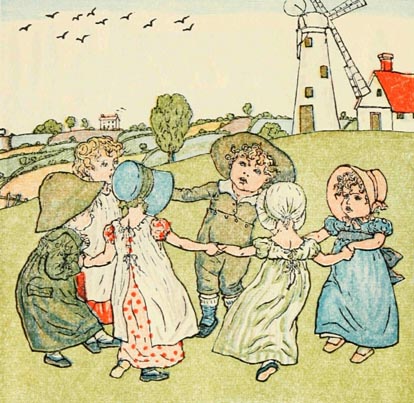
Learn N Blog #10: Ringa Ringa Roses

Source: Wikimedia
Ring-a-round of rosies
Pocket full of posies
Ashes! Ashes!
We all fall down!

All of us have played that kindergarten game where the kids move around in circles joining hands, singing and falling down with the last line. [Video]

When I was young, and not sure about the exact words, would still sing along making up words. So ring-a-round became ringa ringa, rosies turned to roses, posies transformed to poses and as for the third line, it was just random mumbo-jumbo, which we could never figure out.

Now was reading Dan Brown’s Inferno, where the same song was referenced. One theory (which Dan Brown subscribes to) says that this song was about the Great Plague of 1665 in London. Apparently a "ring around the rosie" referred to the pustules which developed on the skin indicating a plague infection. Posies were flowers carried in the pockets to counter the stench of plague. Victims generally just fell down and died and finally were cremated in a bid to destroy the plague (turning into ashes).

While an interesting theory, it is subject to speculation of being just an urban legend. However, how such a lyric became a children’s play song is certainly beyond my comprehension. Children falling down to enact plague victims’ deaths is quite a dark representation! 

Further research on the subject led to snopes.com. They categorically say that this seems a revisionist version of history. There are many versions of the poem with different lines (also explains why I never got the exact words at the time). While the song has been around for centuries, documentary evidence linking it to plague starts appearing only in the middle of the twentieth century. Certainly seems more a case of a theory being fitted to a fact and then the believers taking it up. Dan Brown certainly is known for using lots of symbology in his works all of which are open to interpretation based on your willingness to believe in them.

Overall, the origins are unknown with speculations ranging from simple play-song to church banning dancing to plague. Take your pick.

More Readings
Not a pocket-full but a Bouquet of Posies
Previously on LearnNBlog: Repechage

Monday, January 18, 2016

MovieNotes: The Motorcycle Diaries

Title: The Motorcycle Diaries (Diarios de motocicleta) (IMDB)
*ing: Gael Garcia Bernal, Rodrigo de la Serna
Language: Spanish
Director: Walter Salles
Genre: Biography, Journey

Basic Premise
It narrates the journey made by Ernesto "Che" Guevara when he was a medical student alongwith his friend Alberto and how the journey shaped his life.

MovieNotes
"This isn't a tale of heroic feats. It's about two lives running parallel for a while, with common aspirations and similar dreams"

Thus begins the tale of an epic journey. A journey which sowed the seeds of a revolution into the mind of a medical student. A student who would go on to become one of the most famous revolutionaries of the modern times. 

The move begins on a light-hearted vein with Alberto and Ernesto commencing their trip across the length of South America. They say their farewells and have their little funny adventures on their motorcycle "The Mighty One". However as the journey progresses, the mood of the film changes from fun to seriousness. Their encounters with the different folks awakens them to hardships of the world. The fun-seeking youth who are travelling for the sake of travelling run into people suffering all kinds of hardships and being exploited by those around. The economic inequalities and the sufferings he witnesses makes Ernesto believe that only a revolution (and an armed one) can truly bring about justice.

The movie is a brilliant depiction of the journey and not just in the physical sense. It is more a  story of the transformation within the minds. The sale of the motorcycle half-way through the tale provides an inflexion point in the story from where the movie adopts a more serious tone with the focus shifting from the tale of Alberto and Ernesto to the sufferings of the people they meet. The movie does not tell of any heroic feats but gives an inkling of the the revolution about to come. 

It is one those rare movies which make you think about the injustices around you. 

Rating - 9/10. A tale which begins on a light-hearted note but progresses into something far more serious without losing pace and grip.

Previously on MovieNotes - 12 Years A Slave

Friday, December 21, 2012

The Mayan Misinterpretation

Its 21st December, 2012 - the day of a great apocalypse. The world is going to end. Thats what the Mayans said. Rather what the wise people studying the Mayans interpreted their "calendar" inscribed on a stone. Apparently the dates on the inscribed on the calendar stop on today's date. Hence all this apocalyptic predictions.

The root cause of all the nonsense
But for better or for worse, the world is still here, and going as usual. So why did the dates stop at this point. My possible interpretations to this Mayan conundrum
  1. the Mayan fellow given charge of inscibing the stone must have got bored of his job, OR 
  2. the time cut-off for the work would have reached, OR
  3. he would have run out of space, OR
  4. the calendar thing wasn't meant to prophesize anything at all, OR
  5. the date might have been inscribed correctly but has been misinterpreted as today's date. After all translation has always been a big challenge in communication. So the apocalyptic date could be totally something else, any time in the future. (Tomorrow, day after, month after, next year, next century, next millenium....)
P.S. Poor India TV, what would they do now? Which date to assign for apocalypse?

Thursday, May 05, 2011

Jhansi Ki Rani

I found the following picture on the internet, which claims to be the picture of Rani Laxmibai, the queen of Jhansi. Seems to be taken from a newspaper article. The text below the pic reads as (translated from Hindi) "this photograph was taken 159 years ago by British photographer Hoffman. This was featured in the World Photography Exhibition held in Bhopal (India) on August 19th. This photograph was sent by a collector of antique items in Ahmedabad".
Personally, I have doubts about the authenticity of the claim. Would like to know if this is real or a fabrication.