Showing posts with label Literature. Show all posts

Friday, May 17, 2019

BookMarks #56: Stories From Tagore

Title: Stories From Tagore 
Author: Rabindranath Tagore 
Genre: Fiction 
Setting: Late 19th Century / early 20th Century Bengal 

BookMarks 
The book is a collection of Short stories by Tagore. As per the introduction, it is intended to be used as an English Literature text book for young students. I particularly liked the point about learning language with a context. While the language maybe foreign, the stories are set in the local context, thus making them easier to comprehend. A simple basis for making learning easy and fun! 

Many of the short stories are old favorites (e.g. the Kabuliwalah), while others I made an acquaintance for the first time. The stories are simple, with not too many characters but they can be emotionally draining as well. There is a tinge of grief in nearly all of them. There are not many happy endings in them but almost all stories had a sense of loss! 

While the setting is in British Raj, nearly all characters are Indian. The reader rarely encounters a Britisher! 

Overall, a beautiful piece of work, and certainly a must-read for all Indian literature readers! 

Previously on BookMarks: Krishna’s Secret

Monday, October 29, 2018

BookMarks #47: The Time Machine

Title: The Time Machine
Author: HG Wells
Genre: Science Fiction
Setting: Late 19th Century Britain & way ahead in the future
Published: 1895

Summary
An inventor builds a Time Machine and travels into the future and gets a glimpse of what has become of the intelligent life on Earth.

BookMarks
We do not learn of any character names except Weena, who becomes the time traveler’s companion in the future. Even in the text, when a character addresses another by name, that part is left blank. Almost as if all names have been redacted from the text.

Had read the book at a much younger age, and did not get the many nuances the story has. It isn’t just a tale of an inventor building a Time Machine, finding things different from what he imagined, landing in trouble and managing to get back to his own time after a great adventure. It is also a tale of how even species can diverge if the differences between the haves and the have-nots keeps on rising. The increasing gap here leads to evolution of two radically different species, one of whom even feeds on the other. 

Is evolution circular? A question which crops up while reading the book. The human species hasn’t evolved into a super-human one rather it has effectively moved backwards. There are simple-minded, child-like fun-loving “eloi”, who sustain on fruits and are fascinated by a flame and seemingly have no care in the world. And then there are the savage “Morlocks” who eat the eloi, stay in the dark undergrounds and are scared of fire. Ability to live as a community, agriculture, domesticating animals, building industries and machines – all seem to have been lost alongwith the intellectual capacity to read and write and store knowledge which can be passed on from one generation to other. 

All this happens even while the Earth is still inhabitable. As the time traveler proceeds further into the future, there are changes in the solar system leading to climate changes, which drastically alter the life. This bit is quite understandable because life exists on Earth in its current form because of conditions which are just right. 

Through the time traveler, we also learn how not to depend just on our biases. Every new information he gets, he tries to formulate a theory based on his 19th century understanding. And thus ends up being wrong multiple times. Although he does keep evolving his thought process with passing time. It is quite fascinating to see how new information is processed by our biased brains. We try to immediately bucket new things with what we already know rather than wait for all information. 

The Time Traveler goes into the future and burns down a forest with fire that he has created in order to keep the morlocks at bay. A whole forest destroyed, large scale destruction of species, some species friended and “domesticated” as companions – isn’t that exactly what humans have done during our time on Earth? Go to a new place and drastically change its ecological balance. Since there aren’t many such places left in the present, our narrator has gone into the future and done the same in a matter of days!

The ending is written with an air of mystery, when there is actually none. If the Time Machine is still working, the narrator should not have to wait for his Time Travelling friend for three years to tell his story. The Time Traveler can choose the exact moment of his return.

Fun Fact – The term “time machine” was coined by HG Wells in this book. And it is now the universally accepted term for such a device! Time Machines and Time Travelers may not exist (from what we know now) but Wells certainly was a man ahead of his time!

Previously on BookMarks: Exponential Organizations
Also by HG Wells – The War of the Worlds 

Thursday, December 14, 2017

BookMarks #29: Catch-22

Title: Catch-22
Author: Joseph Heller
Genre: Fiction, War, Satire
Setting: An American air force base in Italy, during the 2nd World War
Published: 1961

Short Summary
This is the story of Captain John Yossarian, a bombardier in the US Air Force based in Italy during the Second World War. The novel narrates the experiences of Yossarian and his fellow airmen, as they go about doing their “duties” while planning to return home.

BookMarks
Catch-22 – The title itself is the book's single biggest contribution to the English language. It describes an impossible situation, a set of paradoxical conditions from which there is no escape. The pilots in the novel need to plead insanity to escape flying any more missions. But their very act of making an insanity plea shows that they are sane and are thus fit to fly more missions. Thus showing that there is no escape.

The narration is pretty weird (probably the reason why it is in most “greatest novels” lists). The story moves in the form of a “jalebi”. One event doesn’t necessarily lead to another. But one incident refers to a previous narrative, sometimes taking it forward, sometimes filling up the backstory and sometimes hanging out as a loose thread to be tied up much later. Overall making it slightly difficult to keep track of the happenings in this non-chronological tale.

There are attempts at humour even in the light of tragedy, making the tragedy even starker. After all, it is a tale of war. There is blood and gore and black humour. As the novel proceeds, it grows grimmer, as we see our characters die one after the other, while also coming face to face with the horrors of war. There is an attempt of the airmen to retain their sanity in light of the goings-on. They question war itself, but carry on with their”duties” while also fighting their own bureaucracy, which at times is an even bigger enemy than the Germans (whom we never see). They are just a bunch of weary men eager to go back home. Nothing sums it up better than the contrast in attitude between Yossarian, a war “veteran” and his roommates who are fresh joinees. 

My favorite line from the book – “that men would die was a matter of necessity; which men would die, though, was a matter of circumstance”. A reminder to the warmongers the world over – that the soldiers dying in the war are also real people. Especially to those who think that bringing up soldiers dying at the borders is a good analogy for any cause.

One word about Milo Minderbinder and his M&M transportation using fleets of fighter aircraft from both sides. There is war and there is business. Sometimes they go hand in hand. And somebody can run a profitable business empire at the sidelines of a world war as well.

Previously on BookMarks: A Feast for Crows

Monday, March 27, 2017

पुष्प की अभिलाषा

आज सुबह की बात है। घर से निकले ऑफिस की तरफ। और जैसा की अक्सर होता है हमारी महानगरी मुम्बई में , आधे रास्ते में फँस गए ट्रैफिक में। वैसे तो यहां की बड़ी और  चौड़ी सडकों को एक्सप्रेस-वे और फ्री-वे बोला जाता है, पर ऑफिस के समय ज्यादातर गाड़ियां रेंगती हुयी ही नज़र आती हैं।  गाड़ी से बाहर झाँका तो नज़र पड़ी डिवाइडर पर। छोटे-छोटे पौधे लगे हुए थे। और फिर ध्यान गया उन पर खिले हुए फूलों पर। बस फिर कहीं दिमाग के कोने से निकल आयी वो कविता जो बचपन में पढ़ी थी - श्री माखनलाल चतुर्वेदी की रचना "पुष्प की अभिलाषा"

चाह नहीं मैं सुरबाला के गहनों में गुंथा जाऊं,
चाह नहीं प्रेमी-माला में बिंध प्यारी को ललचाऊँ।
चाह नहीं सम्राटों के शव पर, हे हरी ,डाला जाऊं,
चाह नहीं देवों  के शीष चढूं, भाग्य पर इठलाऊँ। 
मुझे तोड़ लेना वनमाली , उस पथ  पर देना तुम फ़ेंक,
मातृभूमि पर शीष चढ़ाने, जिस पथ जाएँ वीर अनेक। 

कई साल हो गए, इस कविता को पढ़े हुए। स्कूल के पाठ्यक्रम का हिस्सा था। मुझे याद है टीवी पर भी अक्सर आया करता था। और शायद इसी कारण दिमाग में अच्छे से बस गयी थी ये कविता।  और आज सुबह जैसे ही सड़क के डिवाइडर पर खिले हुए फूलों पर नज़र गयी, सारे शब्द खुद-ब-खुद याद आ गए। 

मनुष्य का जटिल दिमाग - कभी तो अभी पढ़ी हुयी चीज़ याद नहीं आती और कभी अकस्मात् सालों पुरानी भूली हुयी यादें प्रकट हो जाती हैं। 

Sunday, February 26, 2017

BookMarks #21: One Hundred Years of Solitude

Title: One Hundred Years of Solitude
Author: Gabriel Garcia Marquez
Genre: Fiction, Novel
Setting: A fictional town of Macondo in 19th century Colombia
Published: 1967 
Language: Originally in Spanish 

Plot Outline
The novel tells the story of Jose Arcadio Buendia and multiple generations of his descendants and the town of Macondo. We learn the history of Macondo, from being initially settled by Jose Arcadio Buendia and how its rise and eventual fall matches that of the Buendia family. 

BookMarks
The novel belongs to the genre of "magic realism". A phrase which I first encountered in the TV series Narcos. Not surprising given that Narcos is based in Colombia and Macondo has been interpreted as a metaphor for Colombia. So we see sudden unexplained actions during everyday activities which can only be interpreted as divine or magical. So sudden appearances which defy logic are interspersed in the tale of a normal (or rather not so normal) everyday life.

Hundred years is a long time. And as the narrative unfolds, newer and newer elements get added into the scenery. Where we began with only transport means as walking and horses, we end up with stories about aeroplanes and big ships. All the new elements add to the mysticism of the story as it is quite difficult to keep pace with the changes happening at times.

The number of Aurelianos and Jose Arcadios across the family tree cutting across the generations of the Beundia family , and almost all of them growing up under the watchful eyes of the matriarch Ursula, makes it even more difficult to keep track of the events at different times. Their shared characteristics and at times similar actions add to the confusion of the reader, while at times giving an illusion of the circular nature of existence. 

Overall, the book is not an easy read, with characters with similar names and incidents popping across generations making it difficult to keep track. And the story moves in jumps, sometimes covering years in the space of pages. There is hardly any conversation. There is a lot of action happening but the reader does not see it unfold directly. All the action is told through second hand information. The city lives through multiple civil wars and political changes, attacks of plagues and diseases, founding of a new train route, arrival of gringos who setup banana business, all the action happens offline. We hardly witness these upfront. 

An overarching theme is that of circle of life. Macondo rises from the dust and that is where it vanishes with a duststorm. At the very beginning we have the story of a child with a tail and that is where the story ends with another child born with a tail. 

Melquiades is another intriguing character who appears from the beginning of the story. He is shown as a wandering gypsy, who has a heavy influence on Jose Arcadio Buendia. He leaves behind his workshop and a series of parchments in a mysterious script. After over a hundred years, the last of the Buendias  is able to decipher the script. And comes to the realization that the parchments have the story of the entire Buendia family and Macondo. And the story ends as he reaches the end, with Macondo vanishing again. Interestingly the parchments are written in Sanskrit!

Overall, a difficult read but an intriguing work of literature. One can do best not to be sucked into this magic realism!

Previously on BookMarks: Predictions 2017

Thursday, January 19, 2017

BookMarks #19: Inferno

Title: Inferno
Author: Dan Brown
Genre: Fiction
Setting: Modern day Italy & Turkey
Published: 2013

Summary
Robert Langdon, a renowned professor of Symbology, finds himself in a hospital in Florence with no memory of the past few days. With the help of his doctor, Sienna Brooks, he tries to piece together the goings on. As he picks up one clue after another, he finds himself hunting for a virus which threatens to destroy humankind, while being simultaneously being chased around Florence by agents of the mysterious organization, "The Consortium" and its enigmatic head, the Provost. 

The virus had been created by a scientist, Bertrand Zobirist, who has extreme views on ways to contain the human population explosion. His extreme views had led him to be put on a bio-terrorist list by the World Health Organization's Director, Dr. Sinesky. 

The clues for the chase are mixed up in Botticelli's depiction of Dante's Inferno. Langdon uses his extensive knowledge of symbology to gather the clues, while simultaneously being troubled by his temporary amnesia. The hunt for the virus takes Langdon from Florence to Venice and then onwards to Istanbul. During the journey, he learns the mystery of his memory loss, all of which has been staged. Each character is playing out their  own game. But in the end, they are working towards to stop Zobirist's "plague". 

The exercise turns futile as the virus is released and spread throughout the world. However, the virus is different from their initial understanding and it is not a plague which the late Zobirist had released. The book ends with World Health Organization trying to figure out the path forward in this changed world.

BookMarks
And thus we meet Robert Langdon once again. The symobology professor seems to be in more trouble than usual, but that doesn't seem to affect his knowledge of symbols in any way. The book follows Dan Brown's, now patented formula of Langdon, accompanied by a female, being tracked by a mysterious organization while trying to save the world through his knowledge of symbology. All events happening within a 24-hour time frame. Always been a mystery to me how Langdon manages to see different arts and recall their history even with bullets flying all around him.

While the story is gripping, my main issue is with the "staged" plots outlining the main narrative. The revelations in the middle of the tale outlining the staged initiatives are a bit too much to digest. The overhanging tension is pricked like a balloon by these "revelations".


Botticelli's painting depicting Dante's descent into hell, around which the entire plot-line revolves. The book does serve as a good introduction to Dante's classic "The Divine Comedy". However, the interpretations should be backed by the reader's own research rather than sticking to just Mr. Brown's version. (e.g. the ringa-ringa-roses backstory)

Overall, it is an intriguing tale combining interpretations of art with human population explosion under a threat of plague as many a charade play out.

My favorite line - the  quote from Divine Comedy - "the darkest place in hell are reserved for those who maintain their neutrality in time of moral crisis". With all the goings on in today's world, taking the right stand is the only way to counter the forces of evil which are innumerable!

Previously on BookMarks - Wuthering Heights

Tuesday, December 13, 2016

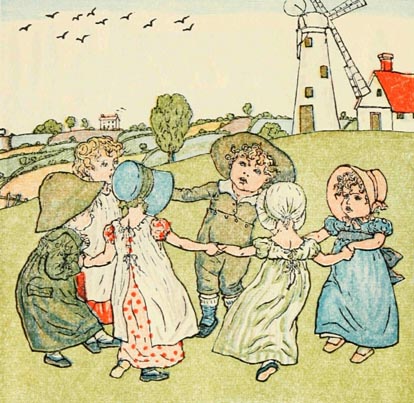
Learn N Blog #10: Ringa Ringa Roses

Source: Wikimedia
Ring-a-round of rosies
Pocket full of posies
Ashes! Ashes!
We all fall down!

All of us have played that kindergarten game where the kids move around in circles joining hands, singing and falling down with the last line. [Video]

When I was young, and not sure about the exact words, would still sing along making up words. So ring-a-round became ringa ringa, rosies turned to roses, posies transformed to poses and as for the third line, it was just random mumbo-jumbo, which we could never figure out.

Now was reading Dan Brown’s Inferno, where the same song was referenced. One theory (which Dan Brown subscribes to) says that this song was about the Great Plague of 1665 in London. Apparently a "ring around the rosie" referred to the pustules which developed on the skin indicating a plague infection. Posies were flowers carried in the pockets to counter the stench of plague. Victims generally just fell down and died and finally were cremated in a bid to destroy the plague (turning into ashes).

While an interesting theory, it is subject to speculation of being just an urban legend. However, how such a lyric became a children’s play song is certainly beyond my comprehension. Children falling down to enact plague victims’ deaths is quite a dark representation! 

Further research on the subject led to snopes.com. They categorically say that this seems a revisionist version of history. There are many versions of the poem with different lines (also explains why I never got the exact words at the time). While the song has been around for centuries, documentary evidence linking it to plague starts appearing only in the middle of the twentieth century. Certainly seems more a case of a theory being fitted to a fact and then the believers taking it up. Dan Brown certainly is known for using lots of symbology in his works all of which are open to interpretation based on your willingness to believe in them.

Overall, the origins are unknown with speculations ranging from simple play-song to church banning dancing to plague. Take your pick.

More Readings
Not a pocket-full but a Bouquet of Posies
Previously on LearnNBlog: Repechage

Sunday, December 04, 2016

BookMarks #18: Wuthering Heights

Title: Wuthering Heights
Author: Emily Bronte
Genre: Fiction
Setting: 18th Century English countryside
Published: 1847

Summary
Young Mr. Lockwood rents a cottage in remote countryside where his nearest neighbour is his landlord Mr. Heathcliff who lives in Wuthering Heights. He in very intrigued by the occupants of Wuthering Heights. His housekeeper at Thrusscross Grange, Mrs Ellen Dean then narrates to him the history of the place. 

How Mr. Earnshaw brought in an orphan boy Heathcliff into his home and raises him with his children Hindley and Catherine. As they grow up Heathcliff falls in love with Catherine but is detested by Hindley. With time Heathcliff through his schemes and charms manages to take ownership of both Wuthering Heights and  Thrusscross Grange. In the meantime, all his peers die while all remain are the younger children who are all victims of Heathcliff's revenge.

The book ends with the death of Heathcliff and the later generation living happily.

BookMarks
In my opinion, it is quite a dark and depressing tale of unrequited love. The lead character is the key villain of the piece and how is revenge seeking wrecks havoc on all those around him, including the one he loves. 

But the one bright spot in this sad tale is in the end we have some signs of normalcy returning to the messed up lives of the survivors.

We have two narrators in the story - the main narrator Mr. Lockwood and the secondary narrator Mrs. Dean who. retells the story to Lockwood.

Previously on BookMarks: Treasure Island

Saturday, September 10, 2016

BooKMarks #17: Treasure Island


Title: Treasure Island

Author: Robert Louis Stevenson
Genre: Fiction, Adventure
Setting: 18th Century England with pirates as backdrop
Published: 1883

Summary
Jim Hawkins is a pub-owner's son. One of the residents is an old sailor, who is worried for the contents of his chest and keeps Jim as a lookout. He is visited by his old shipmates and suffers a stroke and dies. Jim finds a map in the sailor's chest and takes it the local physician Dr. Livesey, after escaping a search of the pub from the sailor's former fellows.

The Doctor believes it to be a map showing treasure buried by pirate Captain Flint. He enlists the squire, Mr. Trelawney, who plans to buy a ship and go in hunt of the treasure. They take Jim along with them. Trelawney hires a crew to manage the ship with Long John Silver, a one legged fellow with a parrot as the ship's cook. Captain Smollett is in-charge of leading the ship but he is wary of Silver and the rest of the crew. As they approach the island Jim manages to overhear Silver's plans of mutiny and warns the Doctor and others.

Once the ship reaches the island, the mutiny is out in the open. Jim and his friends are heavily outnumbered by Silver's crew. At the island Jim runs into Ben Gunn, a marooned sailor, who was part of Captain Flint's crew, who agrees to help him. Jim's friends in the meantime abandon the ship and take fort in a stockade at the island. Jim rejoins his friends and Silver's men take control of the ship. Both sides suffer losses in the battle that follows.

During the night, Jim quietly goes to the ship and cuts her anchor, making her drift away, but has to get onboard to prevent being drowned himself. With the aid of the remaining mutineer on the ship, he steers it into a secluded area. In the ensuing fight, he kills the mutineer and makes way back to the stockade only to discover it having been taken over by Silver and his men and with no signs of his friends.

While the others want to kill Jim, Silver saves his life. The next day the crew alongwith Jim go in search for the treasure. On reaching the spot they discover that the treasure has already been removed by Ben Gunn. The Doctor and his team had met up with Ben Gunn and attack Silver's party. Silver tags up with them while the remaining mutineers are abandoned on the island. 

On the return journey, Silver gives them the slip having made off with a share of the treasure.

BookMarks
An action adventure tale which has become the basis for nearly every pirate tale. A book which has been in my to-read list for ages now. Finally managed to complete it.

It is also a sort of coming-of-age story where a 15 year old boy goes on an adventure. He does things on impulse, which sometime land him in trouble and sometimes bring good fortune to his friends. 

Map of Treasure Island - as drawn by Robert Louis Stevenson - Source Wikipedia
Previously on BookMarks: A Game of Thrones

Friday, August 26, 2016

BookMarks #16: A Game of Thrones

Title: A Game of Thrones
Author: George R R Martin
Genre: Epic Fantasy
Setting: Fictional continent of Westeros, in medieval times
Published: 1996

Summary
“In the Game of Thrones, you win or you die”

That’s the central theme of this epic plot set in the fictional continent of Westeros. It is a tale of seeking power, in the background of political intrigue and conspiracies, with alliances being forged and broken, sworn duty and deaths (lots of them). Multiple plots are in progress across the seven kingdoms of Westeros in a gigantic chess board where each player plays his/her own game. 

We follow the tale of Eddard ‘Ned’ Stark and his family as they are torn apart having been caught in the eye of a raging political storm. King Robert Baratheon and his family arrive in Winterfell to offer Ned the position of the Hand of the King thereby setting up a series of tragic events for the Stark family, which culminate in Ned getting beheaded for treason post King Robert’s death, his son Bran crippled, his daughter Sansa kept near-hostage as new King Joffery’s bethrothed, while younger daughter Arya goes missing. Meanwhile his wife Catleyn and eldest son Robb seek revenge. The book concludes with Robb being appointed as the new “King in the North” by his fellow northern Lords. 

Ned Stark discovers the incestuous relationship of Queen Cersei Lannister and her twin Jaime. He also learns that Robert had not fathered any of Cersei’s children, thus the rightful heir to Robert's throne would be his brother Stannis. But he is betrayed by Petyr Baelish leading to his arrest for treason and later beheading on the orders of new King Joffery, Cersei's son.

Meanwhile, Ned’s bastard son Jon Snow, becomes a sworn brother of the Night’s Watch, at the Wall, which protects the realm from wildlings and mystical creatures. The Wall has its own troubles with frequent disappearances of their rangers, the appearances of undead creatures and the wildling army being raised by Mance Rayder, a former member of the Night’s Watch. Jon’s loyalty to his oath is tested when he hears of Ned’s beheading and Robb’s battles. Jon is also troubled by the disappearance of his uncle Benjen, who had gone beyond the Wall and not returned.

Catelyn captures Tyrion, the younger Lannister brother, the dwarf, accusing him of attacking Bran. This leads to Tywin Lannister unleashing his forces on Catelyn’s family. Tyrion is released with the aid of a sellsword Bronn and joins his father’s forces. During the battles, Jaime gets captured by Robb’s army. Robert Baratheon’s brothers Stannis and Renly also stake their own claim for the Iron throne.

There are multiple references to the events of fifteen years before which led to Robert Baratheon taking over the throne from the “mad” King Aerys Targaryen, with the aid of Ned Stark and Jon Arryn and other Lords. During the rebellion, Aerys Targaryen was killed by his own Kingsguard Jaime Lannister, thus earning him the derogatory title of kingslayer. 

Meanwhile Aerys’s son Viserys is plotting to take back his “rightful” throne. He marries off his sister Daenerys to a tribal warlord Khal Drogo in hopes of gaining control of the Dothraki warriors to mount a challenge for the throne. But his over-eagerness leads to his death at the hands of Drogo. Later when King Robert attempts to kill Daenerys, Drogo is ready to take on the Iron Throne for Daenerys and his unborn child. During a raid, Drogo gets wounded and is attended to by a healer who sacrifices his unborn child for Drogo’s life. But Drogo is left in a vegetative state which lead to Daenerys killing him out of mercy. Drogo’s funeral pyre is lit. Daenerys walks into it clutching the three dragon egg which were her wedding gift. When the pyre burns off, Daenerys is seen with three baby dragons while all remaining Dothraki and Ser Jorah Mormont swear allegiance to her.

BookMarks
This is the first book in the series “A Song of Fire And Ice” and also the basis for the megahit TV show – “Game of Thrones”.

The book is filled with a huge number of characters, too many to fit in such a short summary. Each chapter is told from a central character’s perspective (known as point of view character).

I started reading the books after having seen all the six seasons of the TV series. And also knowing about how the story unfolds makes the reading even more interesting. I could enjoy the details without losing grip of the tale. 

The storyline of the book and the first season are broadly matching. Although the books present a more vivid picture. The biggest difference is that the characters are much younger in the book than in the TV adaptation. Thankfully the TV Show-runners decided to age the characters, otherwise it would have been a show all about teenagers doing adult stuff (which would have been very weird to watch)

Although set as a fantasy in a fictional realm, the storyline has quite a few parallels to the history of Britain. 

Previously on BookMarks – Infinite Sacrifice

Tuesday, August 23, 2016

BookMarks #15: Infinite Sacrifice

Title: Infinite Sacrifice
Author: L.E. Waters
Genre: Fiction, Spirituality, Religion
Setting: Across timelines
Published: 2011

Summary
The story begins with Maya having died, finds herself in a place which is different form her idea of heaven. She meets a spirit guide, Zachariah, who explains to her the rules of gaining salvation from the cycle of life and death. Maya has to review everyone of her re-births.

We see Maya in different forms in different births. First, as a priest in Egypt, who breaks the temple's rules but condemns another for his crimes and meets his end.Then as a lady in Sparta, who tries to protect her progeny from the strict Spartan traditions. In the third stage, Maya is an Irish boy who gets kidnapped by the Vikings and lives amongst them before returning to his own village. In the fourth part, she is an English woman living in the times of plague.

The book ends with Maya moving partially out of her confusion and gaining some insight to her lives. But there are still more re-births to go through.

BookMarks
1st book in "The Infinite" book series.

The story is based on the concept of karma and souls undertaking multiple births before getting salvation. We see the character of Maya empathizing more with her srroundings as we progress through here many births. Also there are certain physical characteristics which pass on in each life and act as a continuity for the soul.

And I wonder, why London is always depicted as filthy and dirty in almost every book that I have read set in the 19th century of before.

Previously on BookMarks: Harry Potter & the Cursed Child

Monday, August 08, 2016

BookMarks #14: Harry Potter and the Cursed Child

Title: Harry Potter and the Cursed Child
Author: JK Rowling, John Tiffany, Jack Thorne 
Genre: Fiction, Fantasy, Play
Setting: The Parallel world of Witches & Wizards
Published: 2016

Official Synopsis
It was always difficult being Harry Potter and it isn't much easier now that he is an overworked employee of the Ministry of Magic, a husband, and father of three school-age children.

While Harry grapples with a past that refuses to stay where it belongs, his youngest son Albus must struggle with the weight of a family legacy he never wanted. As past and present fuse ominously, both father and son learn the uncomfortable truth: sometimes, darkness comes from unexpected places.

Summary
All of us thought that the journey of Harry Potter and his fight with Voldemort was over. And they all lived happily ever after, but as in real life, that is not the case. 

The story continues from the epilogue of the concluding book of the Harry Potter series, Harry Potter and the Deathly Hallows. We follow the paths of Albus Severus, Harry’s son and his new-found friend, Scorpius, the son of Harry’s old school nemesis Draco Malfoy. Both of whom are seeking to survive in the wizarding world, burdened by the names of their fathers’ reputations. Meanwhile, efforts are on to revive Voldemort once again but this time the Dark Lord has a different ally.

BookMarks
We live in the times of cinematic universes with stories spawning from one central theme and going on and on. Seems the Harry Potter universe is also expanding along similar lines with spin-offs and sequels adding to the original tale. And in multiple media - books, movies and now a play [As a fan of the series, I am not complaining].

Lots of references to the previous stories, as would be expected in any fictional universe. Always brought a smile while reading, whenever anyone of the old characters makes a cameo appearance in the tale.

This story is different from the others. After all it is a play and not a novel. Thus we find more dialogues and less action. And that changes quite a bit of the reading of the story. Also necessitating jumps in the storyline. [Reminded me of reading Shakespeare’s Merchant of Venice & Hamlet – compulsory part of our English Literature exams]

I do not like this business of time-travel as a plot device. It is too convenient, creating alternate realities. Although in this case somehow we are spared changes in the main timelines. Add the “Interstellar” inspired source of sending a message through time. Playing with time adds its own share of plot-holes.

Plot-holes (or maybe not)
  • Whose wand is Albus using in the climatic duel?
  • In one of the alternate timelines, how are they taking Voldemort’s name?
  • And with so many illegal time-turners floating around (and in the hand of death-eaters), why wasn't any similar attempt made in the "past"?
Aside - I like the word discombobulated.

After many years, actually managed to read a whole book in a day. In all a fun read.

Previously on BookMarks: The Privateersman

Friday, July 29, 2016

BookMarks #13: The Privateersman

Title: The Privateersman (Google Play Books)
Author: Andrew Wareham
Genre: Fiction, History, Business
Setting: Late 18th Century 
Published: 2013

Summary
The book narrates the story of Tom Andrews. When we first meet Tom, he is running away from the authorities. His father and associates have been killed for piracy. Tom manages to escape with his life but finds himself onboard a privateering ship. With time we watch him grow from a crew member to a leader of the ship to businessman in New York. He moves back to England with his riches acquired in the West alongwith his free slave friend Joseph. They set up their businesses of ironworks and cotton in England. With the help of his sharp business acumen, Tom becomes richer and richer, expands his business interests and acquires a big estate to become a gentleman. The book ends with Tom attempting to fit into the higher society.

Throughout the book, there is an underlying suspense of whether Tom Andrews’ past will catch up to him?

BookMarks
This is the first book of the series A Poor Man at the Gate.

The book provides an insight into the late 18th century business. It shows how the business grew and who profited from them. It acts as a basic guide on how to make more money out of your money. We also learn a few things about economic bubbles and how they are brought up. And who can make profit from bubbles as well. (Something which is true in today’s markets as well).

The book also gives glimpses of the sea-faring life, the business of piracy on the sea, slavery, the culture of high society, the interactions between different cultures and working classes and most importantly the need to fit in. 

Previously on BookMarks: Great Expectations

Tuesday, July 12, 2016

BookMarks #12: Great Expectations

Cover page of 1st Edition, 1861
Title: Great Expectations
Author: Charles Dickens
Genre: Fiction, Social Life, First Person
Setting: Early 19th Century England
Published: 1861

Summary
Great Expectations tells the story of Phillip Pirrip or in short “Pip”. The story is a first person account from Pip. Pip narrates the critical events of his life as he grows up. And how the past events shape his life.

Pip is an eight-year old orphan, living with his cruel sister and her kindly husband, Joe, the blacksmith. One day he encounters an escaped convict, who forces him to get food and a file for him, which Pip does. Next day the convict is again caught by the police, but does not reveal Pip’s secret.

Sometime later Pip is selected for “playing” in a big house owned by an eccentric old woman, Miss Havisham. Here, Pip meets her adopted daughter, Estella, who makes life miserable for Pip. But Pip falls in love with her. After a few years pass in this routine, Pip is assigned as an apprentice to Joe in the forge. 

Mr. Jaggers, a lawyer from London, comes over to the village and informs Pip that he has come up with “expectations” from a secret benefactor, whose condition is that Pip goes to London and become a gentleman. Pip assumes this secret benefactor to be Miss Havisham. Pip moves to London for getting an education. There he stays with Herbert Pocket, a boy his own age and a distant relative of Miss Havisham’s. 

With his “expectations” on the way, we see a transformation in Pip’s character and his attitude towards Joe. He deems that Joe is an unworthy fellow and not a gentleman. Pip begins living a life of extravagance and is in debt. All this with the aim of getting Estella to marry him, something which he feels was also Miss Havisham’s wish. However Estella doesn’t reciprocate his feelings and gets married to another. 

Meanwhile Pip learns that his secret benefactor was none other than the escaped convict, Magwitch. He is initially repulsed by the revelation. Meantime he also learns that Miss Havisham, having been jilted in her younger days, was just toying with him with Estella. Slowly Pip’s attitude towards Magwitch also changes as he learns more about his life. Pip with the help of Herbert tries to take Magwitch along with him abroad, as Magwitch is still wanted for his crimes in England. However, they are caught and Magwitch is sentenced but is very ill. Pip also learns that Magwitch is Estella’s father. Pip tells Magwitch this secret before he dies. With Magwitch’s arrest, all his possessions are seized and Pip’s expectations are gone. Miss Havisham also passes away but acknowledges that she has done wrong with Pip. At Pip’s request she provides a regular sum for Herbert (who is unaware of this) to start his business. 

The ordeal takes a toil on Pip and he falls ill. He is taken care of by Joe, who also pays off all his debts. Pip feels guilty about his treatment of Joe. Finally, he starts leading an honest life working as a clerk with his friend Herbert. 

The book ends with Pip meeting a widowed Estella again at the Miss Havisham’s house. Estella asks for his forgiveness for the wrongs she had done. They walk out together, with Pip seeing “no shadow of another parting with her”.

BookMarks
Great Expectations is a story about characters and their response to sudden change in fortunes (theirs and others). It also tells the story of different social classes and how they look on each other. 

It is also a coming of age tale. The reader grows up with the central character as he matures from a scared young man to an extravagant adolescent to a wiser man. He sees wealth come to him and then go away but he does become a better person in the end. 

Society was quiet different then. A young boy being selected for "playing" at a spinster's home would certainly be seen with raised eyebrows now. Also many of the terms and phrases have gone onto acquire different meanings with the passage of time.

Previously on BookMarks: The Very Best of Common Man

Thursday, February 18, 2016

BookMarks #10: Frankenstein

Title: Frankenstein (or The Modern Prometheus) 
Author: Mary Shelley 
Genre: Science Fiction, Horror 
Setting: Europe primarily Switzerland 
Published: 1818 

Summary 
The story is told in the form of letters written by Captain Walton, who is exploring the Northern Seas, to his sister Margaret, back in England. Captain Walton narrates the tale of a man named Victor Frankenstein, whom his crew had rescued during their expedition in the Arctic Ocean. The crew had also spotted a gigantic figure moving along on the ice earlier. 

Victor begins telling Walton his story and how he came about to be on that icy landscape. He tells Walton about his family in Switzerland, his friends and early life. Then he went to university where the subject of chemistry and natural philosophy interested him the most. He develops a fascination for giving life to non-living things. He creates a large being to replicate human life and his experiments are successful. The “creature” as he refers to it comes into life. However he is repulsed by the creature’s hideous appearance and runs away. When he comes back the creature is missing. 

Victor falls ill from the results of his toils. However, his friend Clerval manages to nurse him back to health. Victor decides to go back to his family in Geneva. He then learns about the murder of his younger brother William and how the boy’s companion Justine has been implicated in it. On visiting the site of the murder, Victor spots his creature lurking around. He is convinced of the creature’s involvement in his brother’s murder and of Justine’s innocence. However, he is unable to stop Justine’s hanging. 

On a trip to the mountains, the creature corners Victor and then tells him his story. The creature has learned to speak and read from observing a family living in a cottage. His earlier interactions with humans had not gone well and he stayed in hiding in their cottage for some months while observing the family. Finally he mustered enough courage to meet the family but his intentions are mistaken because of his monstrous appearance. The frightened family runs away. The creature is angered by this reaction and sets the cottage on fire. Then he sets out in search of Victor, his creator. He also admits to the killing of William. After telling his story, he asks Victor to make a female companion for him, otherwise he would continue troubling Victor’s family. Reluctantly Victor agrees to this but seeks time. 

Victor and Clerval set out for England together. On reaching Scotland they separate. Victor sets to work on creating the female companion. One night he finds the creature watching him. Victor begins to doubt the monster’s promise and proceeds to destroy the female he was building. The creature is angered by his betrayal. He kills Clerval and implicates Victor in the murder. Victor is acquitted of the crime and he returns home. 

Victor gets married to his childhood friend Elizabeth, promising to tell her everything about his worries on the day after their wedding. On the wedding night, the creature comes and kills Elizabeth. Victor is enraged and vows to pursue the monster and destroy him. The pursuit takes him across the world and finally to the Arctics where he meets Walton. 

Fearing that his end is near, Victor makes Walton promise to destroy the monster. Walton agrees. Meanwhile the ship gets trapped in the sea ice. Walton’s crew is reluctant to proceed any further and although Victor argues otherwise, Walton is convinced to drop off the pursuit and return home. 

Victor succumbs to his illness. Walton finds the creature in mourning over Victor’s body. Walton hears the creature’s remorseful pleadings. The creature promises to destroy himself and end his own misery. Walton then watches the creature drift away into the sea. 

BookMarks 
Who is the monster here? Victor Frankenstein or his creation. While the creature commits the murders, he justifies himself due to him being abandoned by his creator, being rejected by the human society and his attempts at friendship being discarded all because of his hideous appearance. Certainly Victor is the one to blame for abandoning his creation. And also for keeping his family and friends in dark about this constant danger that he had created. 

Its a common misconception that the monster’s name is Frankenstein (although many may argue that Victor is the real monster in the tale), the creation is unnamed throughout the tale being referred to as creature or monster. 

Extras
Mary Shelley's original draft
Previously on BookMarks: Uncle Tom’s Cabin

Monday, January 04, 2016

Resolutions Time

A new year has dawned upon us and ‘tis time when resolutions are made. Most of which broken by this time of the year. So instead of making resolution for a year, me decided to make some resolutions for the future (no time frame). And helping me in framing the words is a famous playwright from some centuries back. 

Give thy thoughts no tongue,
Nor any unproportion'd thought his act.
Be thou familiar, but by no means vulgar.
Those friends thou hast, and their adoption tried,
Grapple them to thy soul with hoops of steel;
But do not dull thy palm with entertainment
Of each new-hatch'd, unfledged comrade. Beware
Of entrance to a quarrel; but being in,
Bear't that the opposed may beware of thee.
Give every man thy ear, but few thy voice;
Take each man's censure, but reserve thy judgment.
Costly thy habit as thy purse can buy,
But not express'd in fancy; rich, not gaudy;
For the apparel oft proclaims the man,
And they in France of the best rank and station
Are of a most select and generous, chief in that.
Neither a borrower nor a lender be;
For loan oft loses both itself and friend,
And borrowing dulls the edge of husbandry.
This above all: to thine own self be true,
And it must follow, as the night the day,
Thou canst not then be false to any man. 

These were the words of wisdom imparted by Polonius onto his son Laertes as he is leaving for France to attend university, covering a whole gamut of subjects from friendships to fighting to finances (Hamlet Act I, Scene III). Though written over four centuries ago, the words still hold good, although some of the contexts may have changed. So on the lines of Shakespeare, here are my resolutions. 
  1. Listen to varied opinions but do not put anything on any social media without verifying it through other sources. And certainly not indulge in hate-mongering. 
  2. Be financially prudent. Not be a miser nor a spendthrift. Save first and then spend. Invest after due research and not just a hunch or a tip. Do not get swayed by any get-rich-quick-schemes nor panic on every news event. Keep track of the finances. 
  3. Do not procrastinate. But on the other hand, do look before you leap. Many things sort themselves out with time but many go worse as well.
  4. Spend time with those who really matter. Take more holidays. 
  5. Do my bit to save the environment.
  6. Keep Learning.
  7. And finally “to thine own self be true”. The most important one. After all everything else falls in line after this.
Cheers to a new year and new resolutions

Thursday, September 10, 2015

BookMarks #7: The Jungle Book

Title: The Jungle Book
Author: Rudyard Kipling
Genre: Children’s Fiction
Published: 1894


Like most of my generation, I was introduced to the story of the Jungle Book, through the animated series which came on TV in the early 90s. The adventures of Mowgli and his friends were a staple ingredient of Sunday morning TV viewing. Now all these years I had thought of reading up the novel yet never got down to doing so till now. And then came a surprise for me as “The Jungle Book” turned out to be not one novel but a collection of short stories. Mowgli’s adventures comprise only three of the tales while the others narrate different wildlife tales.

The book comprises of seven short stories 
  1. "Mowgli’s Brothers" is the story of how a human baby, Mowgli got adopted by a family of wolves and how he has to leave the wolf pack to fight the tiger Shere Khan.
  2. In "Kaa’s Hunting", Mowgli gets kidnapped by the Bandar-log and is rescued by his friends Baloo and Bagheera with the aid of Kaa.
  3. "Tiger, Tiger" goes back to main story where an outcast Mowgli reaches a human village and his troubles in adjusting to the human life. Mowgli aided by his brothers also gets into a final decisive battle with his arch-enemy Shere Khan.
  4. "The White Seal" is the story of a young seal Kotick, who searches the oceans for a place away from human beings who hunt baby seals.
  5. "Rikki-Tikki-Tavi" is a mongoose who defends his adopted human family from a pair of snakes.
  6. "Toomai of the Elephants" is a story of a young boy who tends to working elephants set in Indian jungles. He gets the privilege of watching an elephant’s dance. 
  7. "Her Majesty’s Servants" is the story of a night-time meeting of a group of animals all employed in different divisions of Her Majesty's Army. Their meeting is overheard by a British officer.
The stories are all set in late 19th century British India with the exception of the White Seal. The stories mostly depict anthramorphised animals with humans often being the secondary characters. The tales are also intended to be a good moral lesson for all.

Extra – Just to revive the memories of our good old (or young) days


Previously on BookMarks – Mrs Funnybones

Previous appearances of Kipling on NishantzWorld – Bombay & If

Monday, September 07, 2015

BookMarks #6: Mrs Funnybones

Title: Mrs Funnybones
Author: Twinkle Khanna
Genre: Non-Fiction, Anthology
Published: 2015

Tagline – “She’s Just Like You and a lot like me”

“Mrs Funnybones” is a collection of columns by the movie-star turned columnist Twinkle Khanna.

There are in all 26 articles, indexed A to Z each comprising of anecdotes from the writer’s life, sometimes tail-ended with a little life lesson. The inter-connecting theme being the writer’s own life revolving around her family and her work. And while the writer herself is a film-star and belongs to a family of film-stars there are no Bollywood “inside” stories.

The columns are quite witty and the reader rushes through them at quite a rapid pace. The book reads like a series of blog posts (which it really is). However what I liked the most is the end of the article commentary. It’s not just the events but what you can take out from them that makes life what it it mostly enjoyable and sometimes just bearable.

Overall it made for a thoroughly enjoyable, light reading. And my biggest learning – the word “illeism” i.e. the act of referring to oneself in the third person.

Previously on BookMarks: Moby Dick

P.S. The book's style of presenting a slightly fictionalized version of oneself reminded me of my own feeble attempts some years back (link)

Thursday, September 03, 2015

BookMarks #5: Moby Dick

Title: Moby Dick
Author: Herman Melville
Genre: Fiction, Adventure, First Person Narrative
Published: 1851


“Call Me Ishmael”

Thus begins this tome narrating a tale from the mid-19th century whaling industry. The story follows Ishmael, who joins a whaling ship Pequod. The Pequod is led by the mysterious Captain Ahab who is fixated on hunting down Moby Dick, the big white whale, which had been the cause of Ahab losing one leg in a previous expedition. It’s a chase around the globe till the Pequod finally meets Moby Dick, an encounter with tragic consequences to the ship.

The story flows like a whaleship journey (average one taking around 3-4 years). The reader moves along with Ishmael as he goes to Nantucket in search of a job aboard a whaling ship. We learn through him the different aspects of the whaling industry. He makes a new friend, Queequeg and together they are recruited aboard the Pequod which is due to set sail for its three year journey in hunting sperm whales for their oil. Once the voyage has commenced, we meet the ship’s captain Ahab. Here the narrative shifts from Ishmael to Ahab with Ishmael's character retreating to the background. Ahab is interested in only one whale, Moby Dick. For him collecting sperm oil is just a collateral business. His monomania affects the crew, some of whom are reluctant and fearful of him, but they still follow his orders. Finally after a long journey cutting across the oceans, Ahab gets his wish. He finds Moby Dick and gives chase for three days but the whale not only eludes his capture but finally destroys the Pequod. All the Pequod’s crew except for our narrator Ishmael are killed.

The narrative moves at a leisurely pace with the title character being first mentioned only in chapter 36. More than a story it’s a treatise on the whaling industry. The writer often diverting into the details with the hunt for Moby Dick being almost incidental to his treatise. The reader learns a lot about the whaling industry of the mid-19th century e.g. the whaling towns, the hierarchy in the whaling ship and the salary structure, the multi-racial nature of the crew and their various roles on board the ship, the ownership of the oil from the whale etc. The book provides a comprehensive description of different types of whales (as per the prevalent understanding of the time e.g. the whale is a fish with horizontal fin), their physical structure, details of the harpoons used in the hunt, and how a whale is hunted, the process of collecting the whale oil, the uses of sperm oil, even the potential impact of such widespread hunting on the whale population.

The author worships the sperm whale, in his opinion the most magnificent creature on earth. He provides lots of references to myths and religion. There are section with interpretations of various religious works to suit his philosophy of the whale, including stories from Bible and Hinduism (referred to as Shasters). Moby Dick is a scholarly work dealing with everything from mythology to evolution to classification to the commercial exploitation of sperm whales.

The book also provides a glimpse of the life in mid-19th century. Also shows how much political correctness has come into today’s writing and life in general. I don’t think calling a person a cannibal would be appropriate in present time, although may have been completely apt for that period. Or telling an African-American crew member that he would be sold for less than the price of sperm oil.

In short, Moby Dick is the story of one man’s monomaniacal obsession for vengeance leading to his ultimate doom while simultaneously providing a comprehensive discourse on the subject of whales and the whaling industry.

Previously on BookMarks - More Salt Than Pepper

Tuesday, August 25, 2015

BookMarks #4: More Salt Than Pepper

Title: More Salt Than Pepper: Dropping Anchor With Karan Thapar
Author: Karan Thapar
Genre: Non-Fiction, Anthology, Memoirs
Published: 2009

“More Salt Than Pepper” is a selection of columns written by Karan Thapar for the Hindustan Times over a period of eleven years.

The book is divided into multiple sections, with each section clubbing up four to six articles.The articles are short (each comprising of 3-4 pages), with each having its own theme. But what a wide variety of themes do they cover – there are nuggets from the author’s own life, ranging from his school days to his anchoring work, his places of work and visits, the various personalities he has interviewed, a few “inside stories” of the everyday life in the high-flying circles, even about the proper usage of the English language and many more.

“More Salt Than Pepper” reads more like a blog (with lots of posts) than a book. Reading it provides quite a few insights into the author’s personality and the factors shaping them. One also learns that there is much more to a person than the image he/she have put on for the public consumption. 

The book is quite engaging although some articles have become dated as the reader has a benefit of hindsight into some of the “contemporary” events. It just shows how time shapes up our perspectives.

And to me the biggest learning in the proper use of the suffix Mrs. & Ms. In reference to ladies.

Previously on BookMarks – The Hobbit & The Lord of the Rings